Design of ANSI Medium Voltage Switchgear
Product development requires solid, meticulous work. First and foremost, customers demand authentic American-standard metal-clad switchgear compliant with IEEE C37.20.2. What defines authenticity? It is the PowerVac—developed by GE in 1976—the world’s first 15kV, two-tier-height, horizontally withdrawable vacuum circuit breaker switchgear.
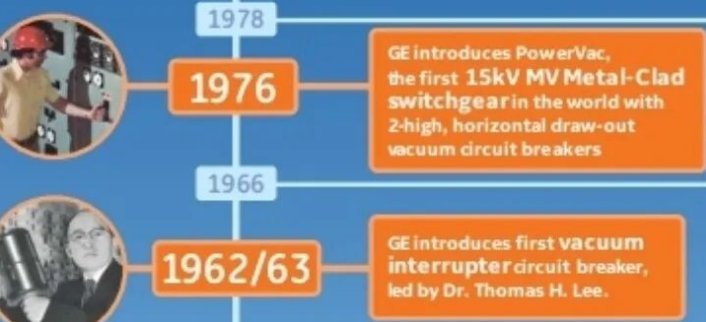 Since then, all U.S.-based companies have manufactured medium-voltage switchgear based on this standard, and the IEEE C37.20.2 specification itself was developed from this very product. In fact, this year marks exactly 50 years since the introduction of this switchgear.
American-style switchgear has unique advantages, particularly in its highly integrated design: the circuit breaker and its compartment are deeply integrated, enabling seamless integration between primary and secondary systems. Current transformers are mounted directly onto the contact box; auxiliary switches for breaker operation and trolley position are installed on the breaker compartment; secondary equipment such as meters and microprocessor-based protection devices are mounted on the door of the breaker compartment. Each compartment thus functions as an integrated unit combining operation, measurement, and protection for a single incoming/outgoing line circuit.
This allows for double-row breaker arrangement or functional trolleys such as voltage transformers, similar to low-voltage switchgear, enabling more outgoing circuits and additional auxiliary functions within a single cabinet.
Both 15kV and 27kV American-style switchgear feature double-row breaker arrangements. Regardless of current rating or short-circuit capacity, the cabinet width remains standardized at 36 inches (914 mm), with phase spacing of 10 inches (254 mm).
American-style breakers require larger wheels so that the breaker trolley can roll smoothly on the floor. The overall dimensions must be compact, especially for high-current contacts up to 3000A. Additionally, the breaker compartment must include spring release mechanisms for withdrawing the breaker.
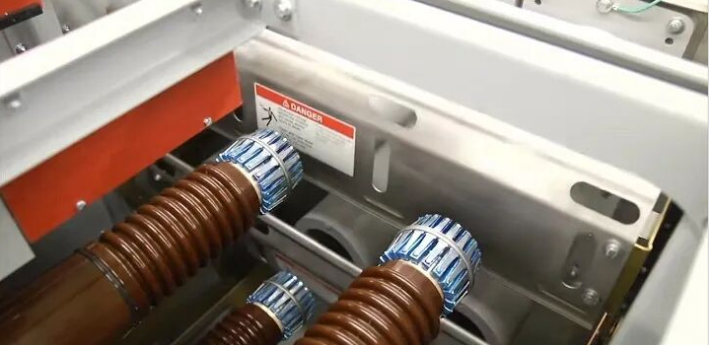
The core of the design lies in the breaker compartment: the static main contacts and contact box, along with a through-type 600V potential transformer mounted directly on the contact box. This necessitates a small outer diameter for the contact box. For 38kV applications, typical phase spacing is 280 mm, meaning the contact box‘s outer diameter should not exceed 176 mm. However, the outer diameter of a 3000A main contact typically exceeds 120 mm, leaving only 28 mm of wall thickness for the contact box. Therefore, internal and external equipotential shielding must be used.
 While 15/27kV switchgear may also adopt a single-row breaker trolley design, the key functional compartments must still meet the requirements of the C37.20.2 standard. According to C37.20.2, no ventilation holes are allowed between compartments. Partition walls must be at least 3 mm thick, while door panels and covers must be no less than 1.9 mm thick. Larger or heavier cover panels require hinges or lifting devices.
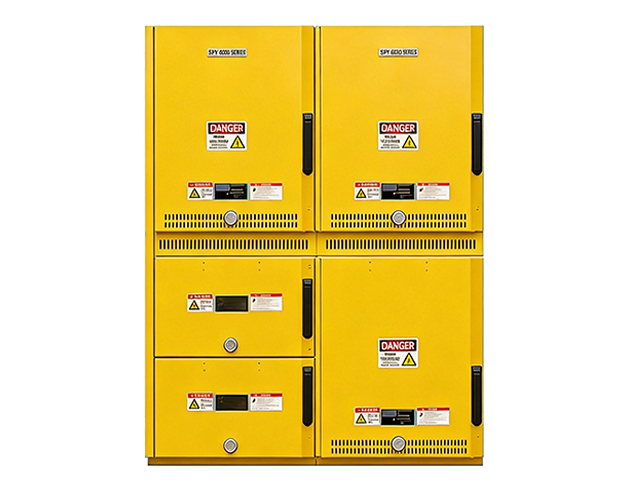 For indoor installations, the standard protection level is generally NEMA 1 (IP2X). Any ventilation openings must maintain sufficient clearance from live parts such as busbars; otherwise, smaller mesh screens must be used to block access. A dust barrier should be installed at the top of the cabinet.
For arc-resistant cabinets, NEMA 1 classification is acceptable, provided the cover can be quickly closed. During normal operation, ventilation remains open; when an internal arcing fault occurs, the cover closes rapidly to prevent arc ejection.
Mechanical interlocks are essential. Since American-style switchgear does not use grounding switches, there is no need for corresponding mechanical interlocks—for example, the rear door panel does not require a mechanism that only allows opening after the grounding switch is closed. There is also no need for electromagnetic locks with forced closure via live indication to secure the rear cover. Instead, simple bolt fastening using tools suffices.
American-style switchgear has unique advantages, particularly in its highly integrated design: the circuit breaker and its compartment are deeply integrated, enabling seamless integration between primary and secondary systems. Current transformers are mounted directly onto the contact box; auxiliary switches for breaker operation and trolley position are installed on the breaker compartment; secondary equipment such as meters and microprocessor-based protection devices are mounted on the door of the breaker compartment. Each compartment thus functions as an integrated unit combining operation, measurement, and protection for a single incoming/outgoing line circuit.
This allows for double-row breaker arrangement or functional trolleys such as voltage transformers, similar to low-voltage switchgear, enabling more outgoing circuits and additional auxiliary functions within a single cabinet.
Both 15kV and 27kV American-style switchgear feature double-row breaker arrangements. Regardless of current rating or short-circuit capacity, the cabinet width remains standardized at 36 inches (914 mm), with phase spacing of 10 inches (254 mm).
American-style breakers require larger wheels so that the breaker trolley can roll smoothly on the floor. The overall dimensions must be compact, especially for high-current contacts up to 3000A. Additionally, the breaker compartment must include spring release mechanisms for withdrawing the breaker.
The core of the design lies in the breaker compartment: the static main contacts and contact box, along with a through-type 600V potential transformer mounted directly on the contact box. This necessitates a small outer diameter for the contact box. For 38kV applications, typical phase spacing is 280 mm, meaning the contact box‘s outer diameter should not exceed 176 mm. However, the outer diameter of a 3000A main contact typically exceeds 120 mm, leaving only 28 mm of wall thickness for the contact box. Therefore, internal and external equipotential shielding must be used.
For arc-resistant cabinets, NEMA 1 classification is acceptable, provided the cover can be quickly closed. During normal operation, ventilation remains open; when an internal arcing fault occurs, the cover closes rapidly to prevent arc ejection.
Mechanical interlocks are essential. Since American-style switchgear does not use grounding switches, there is no need for corresponding mechanical interlocks—for example, the rear door panel does not require a mechanism that only allows opening after the grounding switch is closed. There is also no need for electromagnetic locks with forced closure via live indication to secure the rear cover. Instead, simple bolt fastening using tools suffices.